
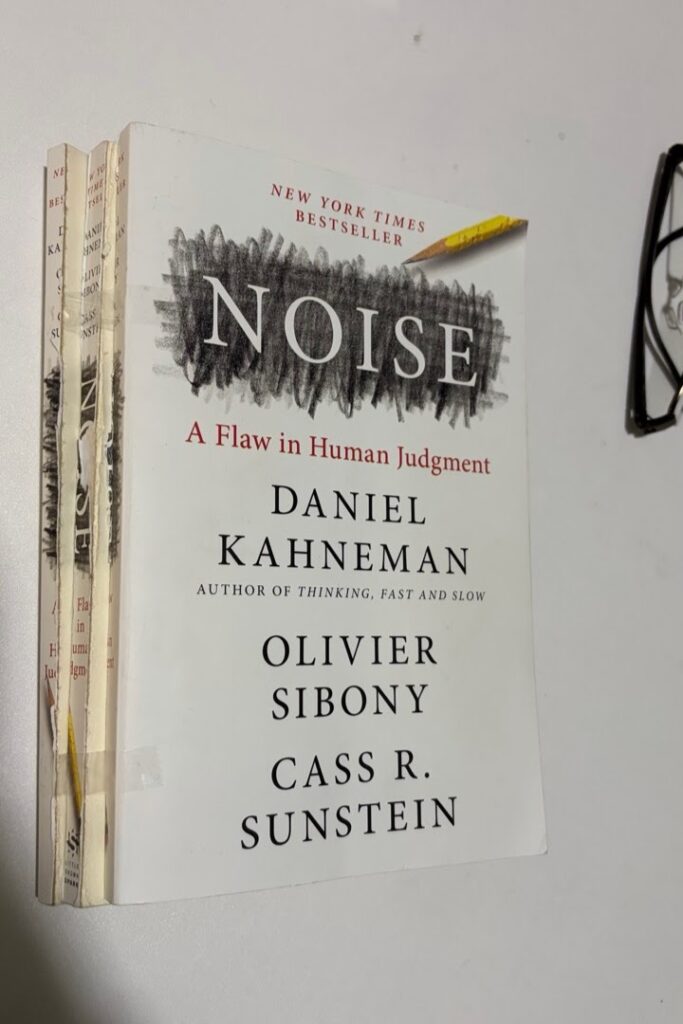
Noise: A Flaw in Human Judgment by Daniel Kahneman
My rating: 4 of 5 stars
I read Noise chapter by chapter, section by section, on and before train rides over the course of a year. I was getting rounds of treatment for chronic dry eye syndrome, and reading a paperback in short sessions was how I assessed my progress during the recovery. The book’s density demanded that pace anyway. Given their verbal style, I felt like going through grad school again. By the way, I used a pair of scissors to cut it into three parts— what I typically do for thick books (another example was Atlas Shrugged).
By the time I finished, I noticed my thinking had shifted slowly. I consciously refrain from taking any single expert’s opinion at face value — not out of distrust, but because the book makes the noisy nature of human judgment impossible to ignore, particularly in healthcare, a field most relevant to me personally, among other fields discussed in this book. Also, think about it: a second opinion, even a second opinion from a diagonal position, may not be sufficient..
I have learned a lot of things that aren’t taught in my field by training, cognitive psychology, such as distinguishing the concept of rules from the concept of standards. Psychology programs are specialized in terms of domain knowledge, and that’s why I care to fill up the blind spots as I age. Books like this are precious, though I wish it could be written in a more digestible way for the general public. I believe the paperback was the best format for me, if you see all the underlines and notes I have around the illustrations.
The book is marketed as a NYT bestseller yet the reading experience is quite different. It’s not the kind of self-help bestseller. Readers without a quantitative background may struggle, while those with formal training in statistics will find the lack of mathematical language a bit frustrating (but that’s the common struggle of psychology as a less-than-hard scientific field: you can’t satisfy both sides). The authors also use “algorithm” loosely, in a way that is inconsistent with its direct meaning in CS. As I first read through the book, I couldn’t help but ask myself whether the authors might be talking about regression models. But not quite. As I later understood, they were talking about calculating methods or something close to that. Anyway, a trained model, rather than the process of training the model.
This brings me to further realization of the unresolved tension here: Dr. Kahneman argues that statistical or AI models should replace noisy human judgment, but those models (including, say, regression models) are trained on human-generated data. You cannot eliminate noise by automating it. It might be harsh to call it cyclic, but it’s like using people to train AI models and then using AI to replace human labor. In my opinion, you constantly need new human data to update the model.
Despite this, Noise is worth reading slowly, with realistic expectations. If you don’t have the time, you can simply jump to the sections you are willing to dig into, but then you may not get much out of it. For readers who have a background in psychology and human science, this book may quietly change how you evaluate judgment. Not dramatically. Those who need I/O psychology in their practice, this book reminds you to hire professionals to do your noise audit.
I acknowledge their contributions to this field.
View all my reviews
This review was originally posted on Goodreads.com